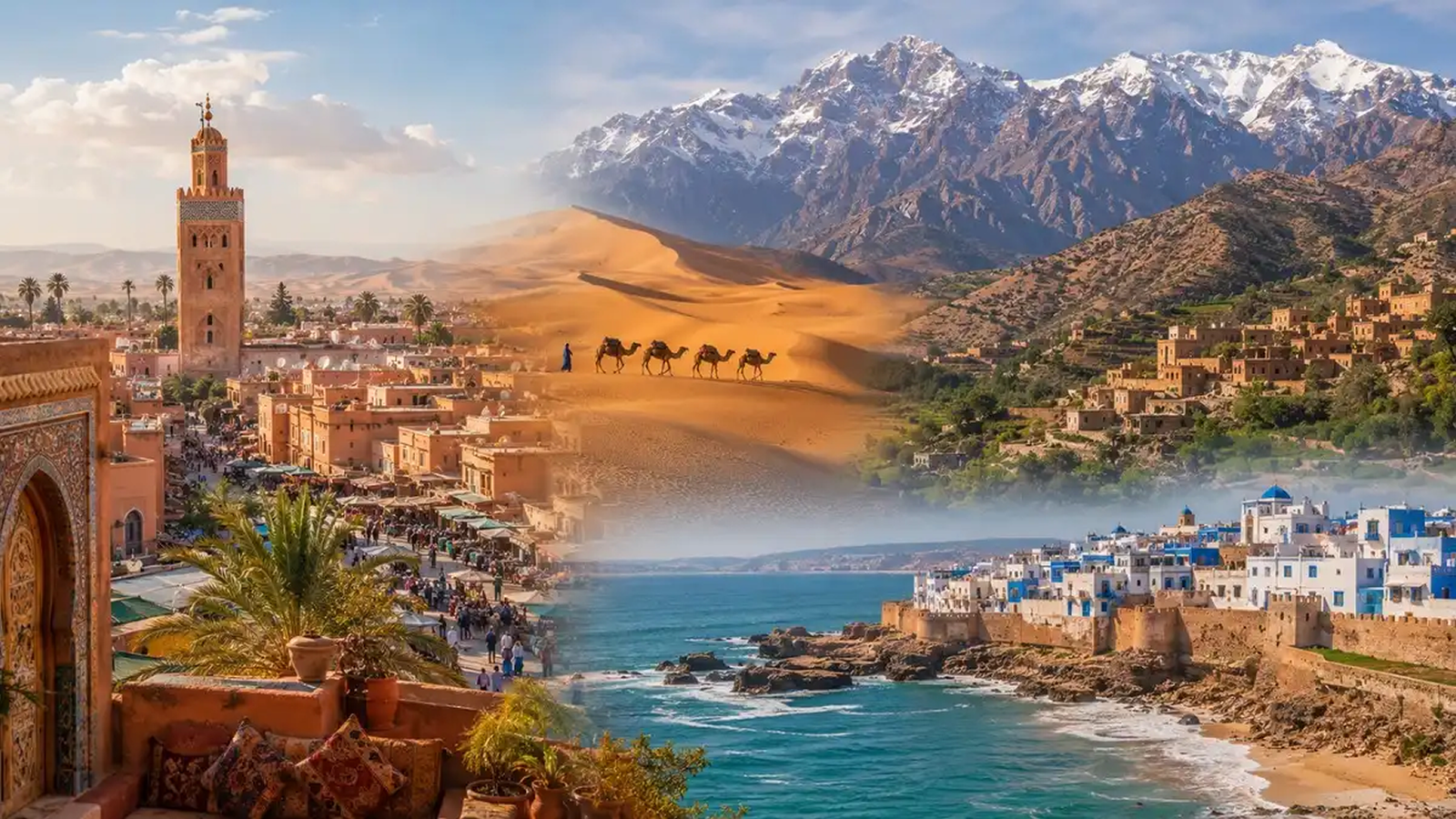
Morocco is one of the most diverse destinations in North Africa. Within a single trip, you can explore medieval cities, colorful markets, ancient kasbahs, dramatic mountains, Atlantic beaches, and the vast landscapes of the Sahara Desert.
From the maze-like streets of Marrakech and Fez to the blue-painted buildings of Chefchaouen and the dunes of Merzouga, Morocco offers a completely different experience from many traditional European destinations.
If you’re planning your first trip to Morocco, these are some of the best places to visit in Morocco.
1. Marrakech
Marrakech is one of Morocco’s most famous destinations and an excellent introduction to the country.
The city’s historic medina is filled with narrow streets, traditional markets, riads, cafés, and historic buildings.
At the heart of the old city is Jemaa el-Fnaa, a lively square that becomes particularly atmospheric toward evening.
Things to do in Marrakech
- Explore the Medina
- Visit Bahia Palace
- See Koutoubia Mosque
- Explore the souks
- Visit Jardin Majorelle
- Try traditional Moroccan food
- Stay in a traditional riad
Marrakech is ideal for travelers who want culture, architecture, shopping, food, and a lively atmosphere.
2. Fez
Fez is one of Morocco’s most historically significant cities.
Its ancient medina is famous for its narrow streets, traditional workshops, historic mosques, and centuries-old architecture.
Walking through Fez can feel like stepping into another era.
Don’t miss
- Fez el-Bali
- Al Quaraouiyine
- Bou Inania Madrasa
- Traditional tanneries
- Nejjarine Museum area
- Local markets
The medina is extensive, so give yourself enough time to explore without rushing.
3. Chefchaouen
Chefchaouen is one of Morocco’s most photographed destinations.
The mountain town is famous for its blue-painted buildings and narrow streets.
Located in the Rif Mountains, Chefchaouen offers a quieter atmosphere than Marrakech or Fez.
Things to do
- Walk through the blue medina
- Explore local craft shops
- Visit the kasbah
- Hike to viewpoints
- Enjoy Moroccan tea
- Photograph the old streets
The town is particularly beautiful in the early morning and late afternoon when the streets are less crowded.
4. Merzouga and the Sahara Desert
For many travelers, spending a night in the Sahara Desert is one of the highlights of visiting Morocco.
Merzouga is a popular gateway to the Erg Chebbi dunes.
You can travel into the desert, watch the sunset over the dunes, spend the night at a desert camp, and wake up early for sunrise.
Sahara experiences
- Desert camping
- Sunrise over the dunes
- Sunset photography
- Camel excursions
- Stargazing
- Traditional desert meals
A desert trip is best planned as part of a longer route rather than a rushed day trip.
5. Aït Benhaddou
Aït Benhaddou is a historic fortified village made up of earthen buildings and surrounded by dramatic landscapes.
The site has been recognized as a UNESCO World Heritage Site and has also appeared in various film and television productions.
Walking through the old settlement gives visitors an opportunity to see traditional Moroccan architecture in a striking desert environment.
It’s often included on routes between Marrakech and the Sahara.
6. Casablanca
Casablanca is Morocco’s largest city and an important economic center.
While it doesn’t have the same atmosphere as Marrakech or Fez, it offers a more modern perspective on Morocco.
The city’s most famous landmark is the Hassan II Mosque, which stands beside the Atlantic Ocean.
Things to do
- Visit Hassan II Mosque
- Explore the Corniche
- Walk through the city center
- Try Moroccan cuisine
- Explore Art Deco architecture
Casablanca is particularly useful as an arrival or departure point because of its international connections.
7. Rabat
Rabat is Morocco’s capital and offers a combination of historic landmarks, coastal scenery, and a more relaxed atmosphere.
The city’s medina is smaller and generally easier to explore than the huge medinas of Marrakech and Fez.
Places to visit
- Kasbah of the Udayas
- Hassan Tower
- Mohammed V Mausoleum
- Rabat Medina
- Bou Regreg waterfront
- Chellah
Rabat is an excellent destination for travelers interested in Moroccan history without the intensity of some of the country’s busiest tourist centers.
8. Essaouira
Essaouira is a coastal city on Morocco’s Atlantic coast.
Its historic medina, whitewashed buildings, fishing harbor, and oceanfront atmosphere make it a popular destination for travelers looking for a slower pace.
Things to do
- Explore the medina
- Visit the fishing port
- Walk along the beach
- Try fresh seafood
- Explore local art shops
- Watch the sunset
Essaouira is also known for its wind, making it popular for water sports.
9. Tangier
Located near the northern tip of Morocco, Tangier has long been influenced by its position between Europe and Africa.
The city overlooks the Strait of Gibraltar and offers a combination of Moroccan culture, Mediterranean influences, historic streets, and coastal scenery.
Explore
- Tangier Medina
- Kasbah
- Grand Socco
- American Legation
- Cape Spartel
- Hercules Caves
Tangier can also be a useful starting point for exploring northern Morocco.
10. Chefchaouen and the Rif Mountains
Beyond the famous blue streets of Chefchaouen, the surrounding Rif Mountains offer opportunities for hiking and nature experiences.
Travelers who have extra time can use Chefchaouen as a base for exploring the surrounding countryside.
The region provides a completely different landscape from Morocco’s desert areas.
11. Ouarzazate
Known as the gateway to the Sahara, Ouarzazate is an important stop on many Moroccan road-trip routes.
The city and surrounding region are known for dramatic desert landscapes, kasbahs, and film studios.
Things to see
- Taourirt Kasbah
- Atlas Film Studios
- Nearby desert landscapes
- Traditional villages
- Scenic mountain routes
Ouarzazate works particularly well as part of a road trip from Marrakech toward the Sahara.
12. Dades Valley
The Dades Valley is famous for its dramatic rock formations, winding roads, valleys, and traditional villages.
The surrounding landscapes are particularly impressive for travelers who enjoy photography and road trips.
The famous Dades Gorge is one of the region’s highlights.
Consider spending at least one night in the area rather than simply driving through.
13. Todra Gorge
Todra Gorge is one of Morocco’s most spectacular natural landscapes.
Towering limestone cliffs rise dramatically around the narrow gorge.
The area is popular with hikers, photographers, climbers, and road-trip travelers.
Things to do
- Walk through the gorge
- Explore nearby villages
- Go hiking
- Photograph the cliffs
- Experience local mountain landscapes
Todra Gorge can be combined with the Dades Valley on a longer journey toward the Sahara.
14. Atlas Mountains
The Atlas Mountains stretch across Morocco and provide some of the country’s most spectacular scenery.
The region offers hiking, mountain villages, valleys, and panoramic viewpoints.
The mountains are particularly accessible from Marrakech, making them an easy addition to a Morocco itinerary.
Experiences include
- Mountain hiking
- Village visits
- Scenic drives
- Traditional meals
- Photography
- Outdoor adventures
For more challenging hikes, use experienced local guides and check conditions before setting out.
15. Agadir
Agadir is one of Morocco’s best-known beach destinations.
The city has a long sandy coastline, modern resorts, restaurants, and access to nearby attractions.
It’s particularly suitable for travelers who want to combine Moroccan culture with a relaxing seaside holiday.
Things to do
- Relax on Agadir Beach
- Visit the Agadir Oufella area
- Explore local markets
- Try Moroccan seafood
- Visit nearby coastal towns
Agadir can also work well as a base for exploring southwestern Morocco.
Best Places in Morocco for Different Travelers
Morocco offers something for several different travel styles.
For first-time visitors
Marrakech, Fez, and the Sahara provide a strong introduction to Moroccan culture, history, and landscapes.
For couples
Consider Marrakech, Essaouira, and the Sahara Desert for a combination of romantic accommodation, coastal scenery, and desert experiences.
For adventure
The Atlas Mountains, Todra Gorge, Dades Valley, and Sahara offer hiking, road trips, and outdoor experiences.
For beaches
Essaouira and Agadir are two popular choices for coastal travel.
For history and architecture
Fez, Marrakech, Rabat, and Aït Benhaddou offer some of Morocco’s most interesting historic environments.
For photography
Chefchaouen, the Sahara, Aït Benhaddou, the Atlas Mountains, and the Dades Valley all provide distinctive landscapes and architecture.
How Long Do You Need in Morocco?
For a first visit, 7 to 10 days can provide a good introduction.
A shorter trip could focus on:
Marrakech → Atlas Mountains → Aït Benhaddou
With 10 to 14 days, you can create a more varied route:
Marrakech → Aït Benhaddou → Ouarzazate → Dades Valley → Todra Gorge → Merzouga → Fez
With additional time, you can add Chefchaouen, Essaouira, Rabat, or the Atlantic coast.
Best Time to Visit Morocco
Morocco can be visited throughout much of the year, but the best season depends on your itinerary.
Spring
Spring is generally attractive for exploring cities, mountains, and the desert.
Summer
Summer can be very hot in inland and desert regions, while coastal destinations may be more comfortable.
Autumn
Autumn can provide comfortable conditions for city exploration and desert travel.
Winter
Winter can be mild in many cities but colder in the mountains and desert at night.
If you’re planning a Sahara trip, remember that desert temperatures can change considerably between daytime and nighttime.
Moroccan Foods to Try
Food is an essential part of a Morocco trip.
Try regional specialties such as:
- Tagine
- Couscous
- Pastilla
- Harira
- Moroccan salads
- Grilled meats
- Fresh seafood
- Mint tea
- Moroccan pastries
- Dates and dried fruits
Local markets and traditional restaurants are excellent places to experience Moroccan flavors.
Morocco Travel Tips
Dress respectfully
Morocco is culturally diverse, but modest clothing is generally appropriate, particularly when visiting religious and traditional areas.
Carry cash
Small shops, markets, and local businesses may not always accept cards.
Take your time in the medinas
The historic quarters can be confusing, so use reputable guides when appropriate.
Plan desert journeys carefully
Distances between destinations can be significant. Avoid creating an itinerary that requires long drives every day.
Respect photography rules
Ask before photographing people, particularly in markets and rural areas.
Keep some flexibility
Morocco rewards travelers who leave room for spontaneous stops, local meals, and unexpected discoveries.
Final Thoughts
Morocco is much more than Marrakech.
The country brings together ancient cities, mountain landscapes, Atlantic beaches, desert dunes, historic kasbahs, and traditional villages.
You can spend one morning wandering through the blue streets of Chefchaouen, travel through the Atlas Mountains, watch the sunset over Sahara dunes, and finish your journey exploring the historic medina of Fez.
For a first trip, focus on a few regions rather than trying to see the entire country.
A route combining Marrakech, Aït Benhaddou, the Dades or Todra region, Merzouga, and Fez can provide an especially varied introduction to Morocco.
Take your time, explore beyond the major tourist centers, and allow the country’s food, architecture, landscapes, and local culture to become part of the journey.